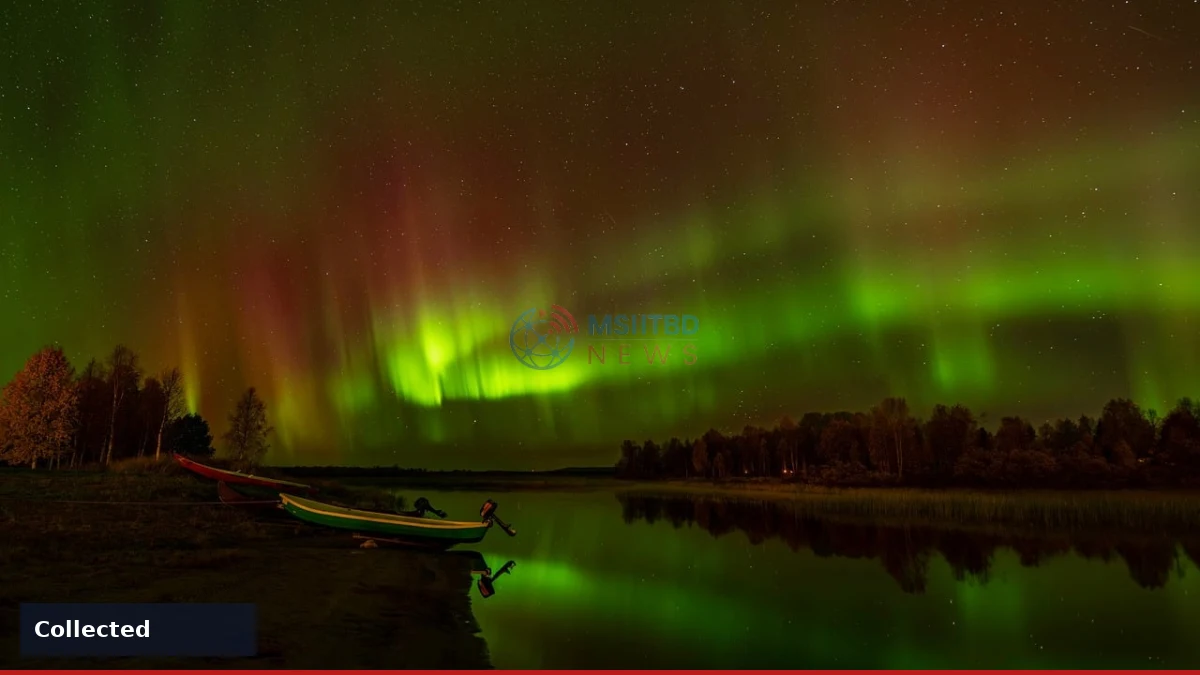
A rare burst of solar wind could light up the night sky far beyond the usual aurora zones.
Key points
- A large coronal hole is sending solar wind at 342‑404 mph toward Earth, faster than average.
- NOAA predicts G1‑G2 geomagnetic storm conditions from Nov 6‑8, with possible aurora visibility down to New York and Idaho if G2 materializes.
- The strength and direction of the solar wind’s magnetic field will determine how far south the lights can be seen.
- Dark, northern‑facing locations and real‑time space‑weather apps give the best chance to view any aurora activity.
A massive coronal hole on the Sun is channeling a stream of unusually fast solar wind toward Earth, setting the stage for a possible aurora display this weekend, according to NOAA’s Space Weather Prediction Center.
The hole, described by NASA’s Solar Dynamics Observatory as oddly shaped, is expected to produce wind speeds of 342 to 404 miles per second (550‑650 km/s), well above the typical 249 mph (400 km/s) flow, the U.K. Met Office reports.
What’s driving the potential aurora surge?
NOAA has issued a minor (G1) geomagnetic storm outlook for November 6‑8, with a chance of moderate (G2) conditions on the 7th and 8th. If G2 levels materialize, auroras could be visible as far south as New York and Idaho, while under G1 they may be limited to northern Michigan and Maine.
Aurora forecasts remain uncertain because the storm’s impact depends on the orientation of the incoming magnetic field; a southward‑pointing field would allow more energy to couple with Earth’s magnetosphere, enhancing the display.
Forecasted storm levels and possible viewing locations
For those hoping to catch the lights, dark skies away from city glow and a clear view of the northern horizon are essential. Space‑weather apps such as “My Aurora Forecast & Alerts” and “Space Weather Live” can provide real‑time updates on conditions.
Reader questions
When is the high‑speed solar wind expected to reach Earth?
The fast stream is forecast to arrive around November 6‑7 and could continue through most of the weekend, persisting into November 9.
What conditions are needed for the northern lights to be visible in places like New York?
A moderate (G2) geomagnetic storm, which requires a strong, southward‑oriented magnetic field in the solar wind, would be necessary for auroras to be seen that far south.
Source: space.com